
Upgrading to more efficient cellular radio towers could save enough electricity to power cities like Phoenix, New Orleans or Seattle, according to a new study by US research firm J. Gold Associates.
Each year, US cell sites use a total of nearly 21 million megawatt hours (MWh) of electricity. This is the equivalent of the average power used by nearly two million households.
“Cellular services have become an essential infrastructure element of modern life. It is hard to imagine not being able to communicate on the go with our mobile devices, or increasingly through a wireless home gateway enabling Internet services to residential and business customers,” the report states. “But it’s not often talked about the burden that the many cell sites place on the electricity supply needed to keep them powered and the costs associated with providing electricity.”
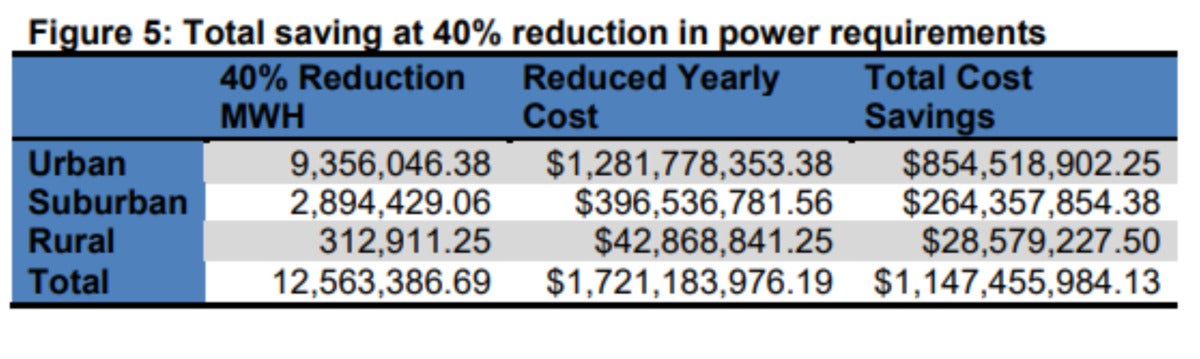
Every 10% reduction in total cell site power saves enough electricity to power the equivalent of 195,000 homes. And a 40% reduction provides enough electricity to power the equivalent of nearly 782,000 homes, according to the US Cell Sites – a Sustainability Analysis study.
By upgrading both radio hardware and management software, each cell site could save up to 40 percent of its electricity needs, the report says.
 J. Gold Associates
“Sustainable reuse of electricity can be used to power a large number of equivalent households without the need for new energy sources,” the report says. “The amount and cost of electricity to run our modern cellular infrastructure is enormous and has an effect on user subscription costs as well as the load on the electrical grid and the creation of greenhouse gases at from electricity generation.
“It would be beneficial for the industry to move in this direction as soon as possible,” concludes the study.
A modern, high-performance cell site would likely cost around $200,000, according to Jack Gold, principal analyst and report author. Each carrier would be responsible for their own equipment, even if they share a physical tower with others. Typically, the tower is owned by a tower company, which then leases the site to the various operators (similar to a multi-unit rental such as a condominium or apartment building).
“So each carrier is responsible for their own equipment upgrade,” Gold said in an interview.
 Ericsson
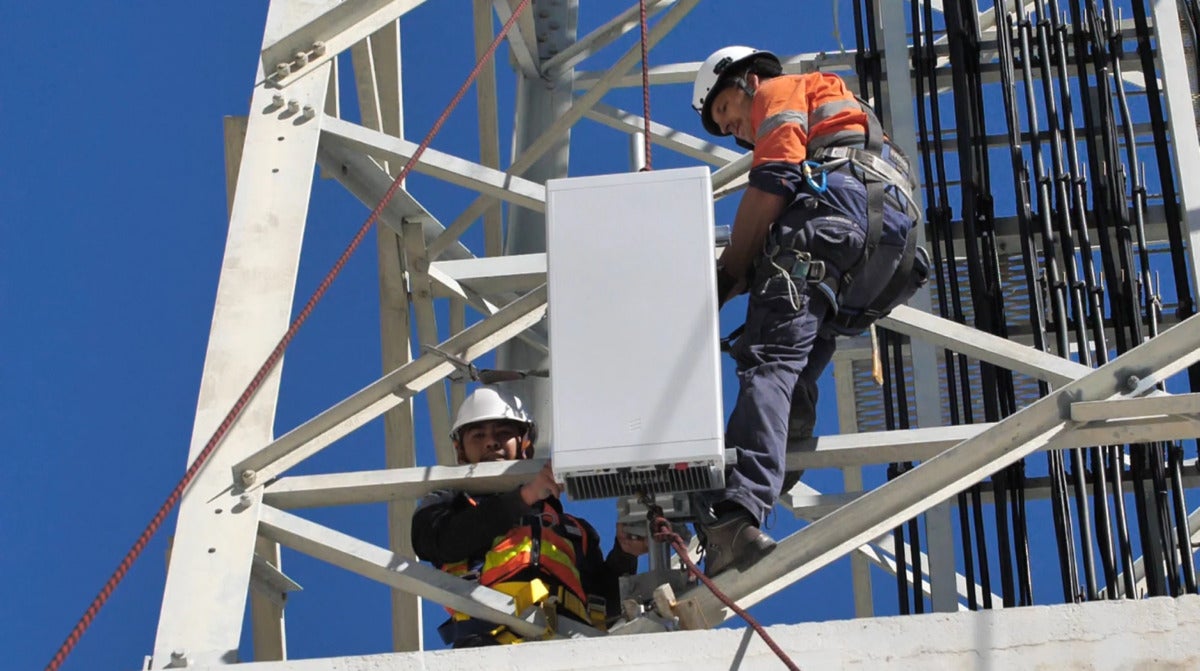
Telco employees install a 5G antenna on a cell tower.
According to the Cellular Telecommunications Internet Association (CTIA), there were 417,215 cell sites in the United States at the end of 2020. Although this number is a moving target, as new cell sites are added as new domains and /or services are deployed, J. Gold Associates used this number for its report calculations. (The CTIA is a trade association representing the US wireless communications industry.)
The radio element of a cellular telecommunications network is called RAN (short for radio access network). The typical RAN lasts about eight years before needing upgrades or replacement, Gold said.
(Because there is a wide variation in the age of cell sites around the world, it is difficult to estimate how many currently need to be replaced, according to a spokesperson for Swedish networking and telecommunications company Ericsson.)
Instead of just replacing old hardware, moving to a more virtualized environment rather than dedicated hardware will help reduce the overall power requirement, Gold said.
AI offers opportunities
Additionally, by using artificial intelligence (AI) in cell site management software, service providers can operate infrastructure more proactively with tools to control passive equipment and enable predictive maintenance and resolution. contactless issues to reduce costs, site energy consumption and site visits. .
 J. Gold Associates
“AI tools are useful for managing cell site hardware, better understanding the amount of power needed for each connection, rather than just turning radios on and off at full power, which is essentially what’s happening. on older equipment,” Gold said. . “If you’re near the tower, you don’t need to give me a full-strength signal.”
The AI can also recognize previous patterns and manage equipment based on that (the software could “learn” that a site rarely has traffic from 2am to 3am and put it on minimum power). This type of granular management can significantly reduce power. And better antennas, such as more efficient Massive Multiple Input Multiple Output (MIMO) 5G devices, can also help limit the broadcast power needed.
 Ericsson
A 5G antenna on top of a roof.
Ericsson recently announced a more energy-efficient RAN powered by the company’s latest-generation silicon, which it claims consumes 25% less power. The portfolio update includes everything from dual-band radios to ultra-light Massive MIMO radios, low-profile antennas and power-saving software features.
“Additionally, newer devices may have software installed that can interact better with management to accommodate a range of power-saving features, just as newer PCs also do better than older PCs,” said said Gold.
Another crucial element for energy efficiency, according to Ericsson, is the radio’s power amplifier (PA) used to generate the signals to be transmitted. Typically, the PA consumes over 60% of the radio’s power. As a result, radio hardware efficiency can be optimized for the specific output power or configuration used by continuously integrating more discrete stages into a single package, adopting new technology such as gallium nitride (GaN) to high-efficiency PA technology and wideband multi-band radios, said Ericsson’s spokesman.
The move to 5G also plays a role
Around a quarter of the world’s population currently has access to 5G coverage. Some 70 million 5G subscriptions were added in the first quarter of 2022 alone, according to Ericsson. By 2027, around three-quarters of the world’s population will be able to access 5G, according to Ericsson’s June 2020 Mobility Report.
Since inception of the 5G RANs in 2015, Ericsson said it has shipped 8 million devices to its customers – “the most installed 5G-enabled radios in the industry”, a spokesperson said by email.
Today, there are around 210 5G networks in commercial service, and Ericsson claims to lead the market with around 50% (120 networks) of global mobile 5G traffic outside of China.
In a previous report, Ericsson claimed that there is a perception that older equipment at cell sites can handle increased traffic demand from more mobile devices and upgrades. to 5G, which the company disputes.
“The transition from 4G to 5G is causing a huge increase in computing requirements – they have increased more than 150 times,” the Ericsson spokesperson said. “While general purpose compute solutions can be used for 5G, to truly deliver 5G performance with the highest power efficiency, you need purpose-built silicon. Ericsson’s system-on-chip (SoC) design is the optimal solution to achieve this.
Ericsson says its all-new 5G radio system can reduce power consumption by around 30% when used to upgrade current infrastructure. The system supports standalone and non-standalone 5G, 4G, 3G and 2G access technologies. “It delivers high levels of orchestration and automation for operational efficiency, and saves up to 20% on infrastructure with cloud-native operations,” the company said.
“In some cases, it even pays for the upgrade within three years,” the company said in its report. “Customer cases show that service providers have reduced site energy consumption by up to 15% with smart site control solutions.”
However, some studies claim that 5G consumes up to twice as much power as 4G systems. “A typical 5G base station draws up to twice or more the power of a 4G base station,” wrote Matt Walker, chief analyst at MTN Consulting in a report titled “Operators Facing Energy Cost Crisis “.
Copyright © 2022 IDG Communications, Inc.