
Nvidia’s Deep Learning Super Sampling (DLSS) has been an undeniable selling point for RTX GPUs since its launch, and AMD’s attempts to fight back haven’t exactly been home runs.
But what if FidelityFX Super Resolution (FSR) could grant the huge performance gains of DLSS without all the restrictions imposed by Nvidia? If it sounds too good to be true, I wouldn’t blame you. After all, Nvidia’s special machine learning sauce wasn’t meant to be easily replicated.
Well, hold on to your hat, because a modder recently discovered how easily FSR can mimic DLSS. And after trying the solution myself, it made me more excited than ever about the potential of FSR.
what we have now
Before we get to the mod itself, it’s worth laying the groundwork for how we got here. FSR was AMD’s first attempt at a DLSS killer, and unfortunately it left a bad taste in our mouths. Despite the rapid adoption of the first generation of FSR 1.0, performance and image quality simply didn’t measure up.
That all changed with the release of the second generation of the technology. I tested FSR 2.0 in its launch title, Death Loop, and the results are clear: DLSS offers a slightly greater performance boost, but FSR 2.0 is nearly identical in image quality. Based on Loop of death, you should use DLSS if you can, but FSR 2.0 is pretty close if you don’t have a supported GPU.
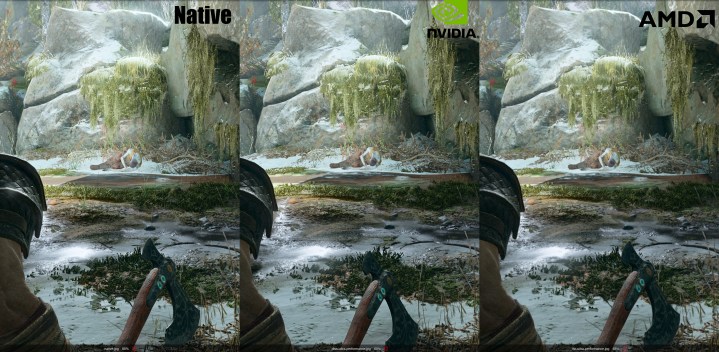
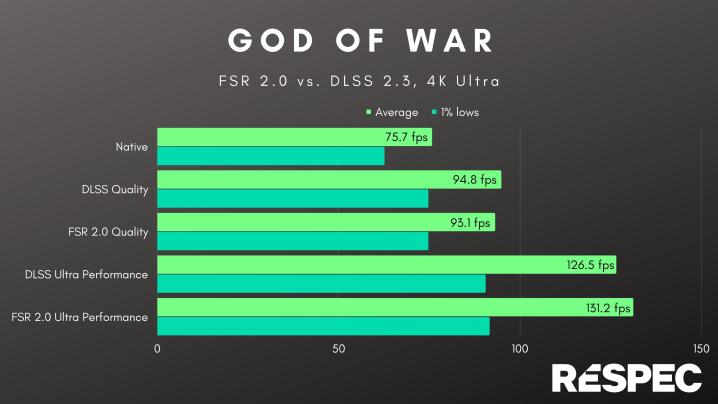
My expectations were exceeded again when I tested God of the war, seeing the margin with DLSS shrink even more. In fact, FSR 2.0 was actually around 4% faster than DLSS with the Ultra Performance preset. You don’t trade much with image quality either. Even with the intense Ultra Performance preset, it’s nearly impossible to spot the differences between FSR 2.0 and DLSS during playback.
This is the real deal. The only problem? FSR 2.0 is technically available, but it does not see rapid adoption of the first version. It’s only available in four games now: Deathloop, Farming Simulator 22, God of War, and Tiny Tina’s Wonderland. The upcoming list isn’t that exciting either, headlined by Hitman 3, Eve online, and the recently delayed Speak.
Hence the need for a seemingly impossible solution that takes the qualities of FSR 2.0 and broadly extends its effect to as many titles as possible. And that’s where the fun begins.
A look into the future

About a month ago modder PotatoOfDoom released an FSR 2.0 “hack” for Cyberpunk 2077. What the modder realized was that DLSS and FSR 2.0 essentially require the same information – motion vectors, color values, and depth buffer. This allowed PotatoOfDoom to create a simple instruction translation, using the DLSS backbone to send FSR 2.0 instructions. It’s like how Wine works for Windows games on Linux, according to the modder.
I’ll come back to what these similarities between DLSS and FSR 2.0 mean, but let’s get the games out of the way first. I followed the instructions and was able to implement the mod in Cyberpunk 2077, Dying Light 2, and Eternal Destiny — all games that do not currently support FSR 2.0. Eternal destiny was the only game that struggled with the mod, blocking the DLSS option entirely in the settings menu. It was forbidden.
But Cyberpunk 2077 and Dying Light 2 were an absolute treat. The mod isn’t as powerful as a native implementation, but it still comes pretty close. The difference is less than 10% at maximum, even with all settings increased to 4K (including the highest ray tracing options).
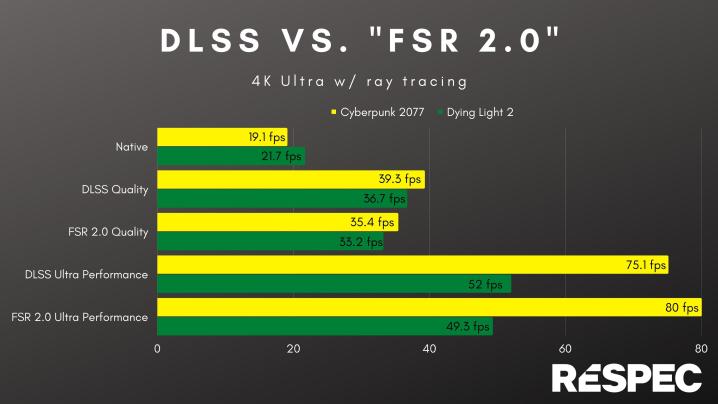
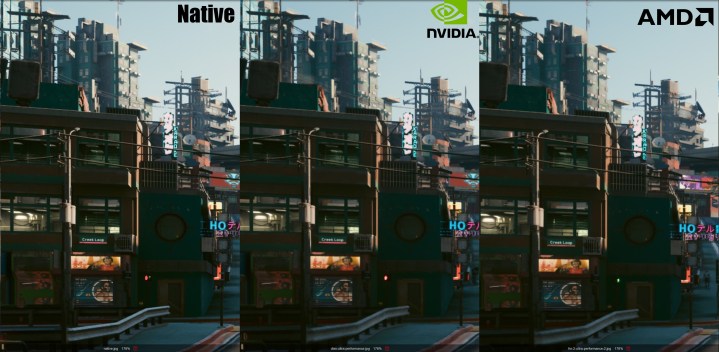
Image quality was just as good, even on this self-proclaimed hack. In a still image, Dying Light 2 actually looked slightly better with FSR 2.0, and it was almost identical in Cyberpunk 2077. The main difference, as was the case in God of the war and Loop of death, is that FSR 2.0 doesn’t handle remote fine detail either. You can see it on the phone lines of Cyberpunk 2077 below. It’s pretty darn close, though.
DLSS and FSR 2.0 largely look the same with a still image, but it’s the motion that counts. I saw big ghosts in Dying Light 2 which was not present with DLSS or FSR 1.0, and flat textures cause masking issues.
Some elements, such as sewage smog from the Cyberpunk 2077 screenshot below, do not include motion vectors. FSR 2.0 and DLSS get around the problem of hiding the element (as in Photoshop) so that it is not included in the oversampling. Unfortunately, they do the masking in different ways, leading to the nasty pixelation with the FSR 2.0 hack you can see below.
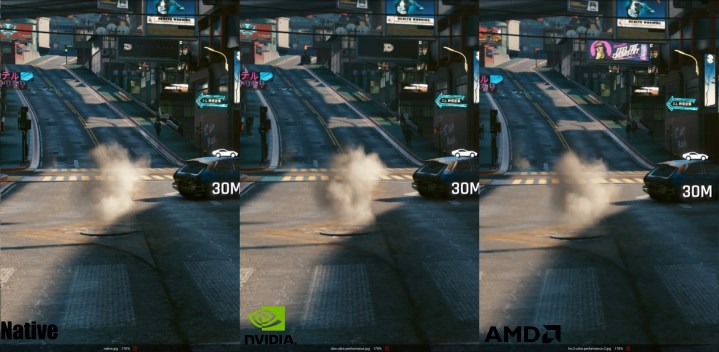
Even with these issues, it’s remarkable how close DLSS and FSR 2.0 are, both gameplay-wise and technically. PotatoOfDoom summed up everything they share in an interview with Eurogamer: “I was expecting to work on [adding FSR 2.0] for several days, but I was pleasantly surprised that it only took me a few hours to fit in.
The point is not that you should necessarily go out and use this mod to add FSR 2.0 to every game. On the contrary, this mod reveals the deep similarities between DLSS and FSR 2.0 – something Nvidia might not readily admit.
Eliminate deep learning from oversampling
DLSS is about machine learning; it’s right there in the name. And at this point, Nvidia has insisted for years that DLSS only works on its newer graphics cards because they provide the AI cores needed to perform the oversampling. True, but FSR 2.0 is proof that the advantage provided by AI is weak and, for the most part, unnecessary.
A big reason Nvidia’s GPUs sell above list price is DLSS, even though it’s not necessary.
There are many similarities between DLSS and FSR 2.0, even when it comes to Nvidia’s machine learning bit. DLSS uses a neural network and FSR 2.0 uses an algorithm, but both are fed with the same inputs and use the same overall system to render the final output. The fact that PotatoOfDoom was able to develop a mod that works on multiple DLSS titles in a matter of hours is proof of that.
The main problem is no longer that DLSS is bad – it’s great, and you should use it if you can – but that the feature is exclusive to a few expensive graphics cards. Even when GPU prices drop, Nvidia’s low-end and mid-range models continue to sell above list price. And a big reason why is DLSS, even though it’s not necessary.
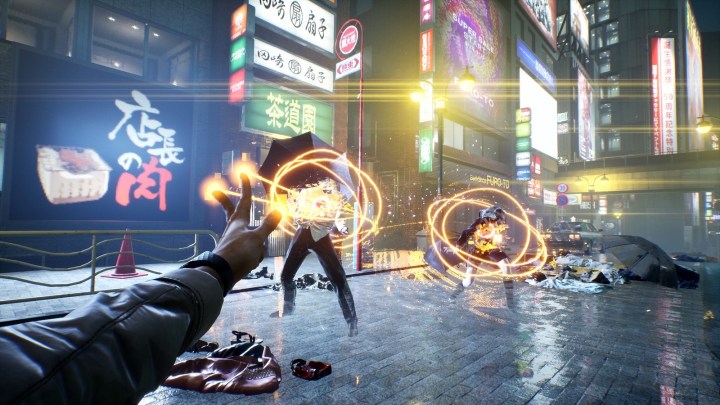
General purpose solutions like FSR 2.0 and Unreal Engine’s TSR (Super Temporal Resolution) are the way of the future. They work with virtually all modern hardware, and the developers constantly insist that they only take a few hours to work.
DLSS doesn’t need to go away, but it would be nice to see Nvidia leverage its developer relationships to get a general-purpose upsampling feature in games that already support DLSS. And no, Nvidia Image Sharping, which is essentially FSR 1.0, doesn’t count.
Catch up
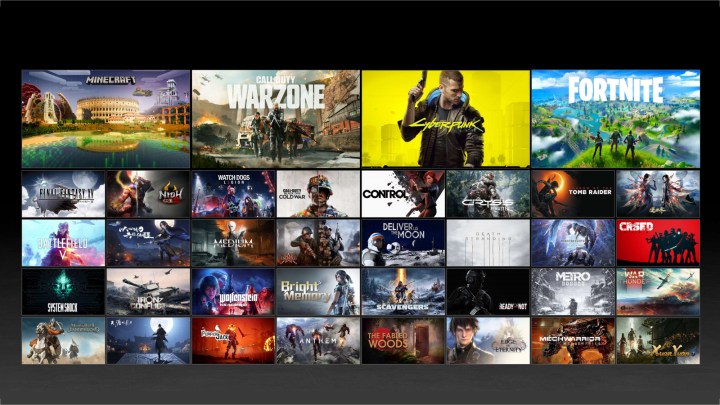
FSR 2.0 is really impressive, but the game support holds it back. Many more games support DLSS than even FSR 1.0, and the official list of four FSR 2.0s is puzzling. I’m also not excited about too many upcoming FSR 2.0 titles, as the list is mostly made up of older or smaller games.
PotatoOfDoom’s mod is a sign of hope, but we need more FSR 2.0 games for it to even have a chance against DLSS. It may be tempting to root AMD here, but it’s important to remember that DLSS still has a minor lead and is supported in many more games. AMD has a long way to go and FSR 2.0 is not being added to games at nearly the same rate as FSR 1.0.
Still, it will be interesting to see how the dynamic between DLSS and FSR 2.0 adjusts over the rest of the year. AMD just released the FSR 2.0 source code in June, after all. For now, DLSS is still the way to go for its gaming support and slightly better image quality, but that’s not a selling point on an Nvidia GPU like it once was.
This article is part of ReSpec – an ongoing bi-weekly column that features in-depth discussions, tips and reports on the technology behind PC gaming.
Editors’ Recommendations