
Apple with iOS 16 added a new medication management feature to the Health app, which is designed to allow users to track their medications to ensure a dose is not missed. The feature works with a new Medicines app on the Apple Watch, and it’s useful for everything from prescriptions to vitamins.
This guide covers everything you need to know about the medication tracking feature as well as other new features in the iOS 16 Health app.
Medication Tracking
“Drugs” is a new section available in the Health app, accessible by going to the Browse section and scrolling down to Drugs, or typing it into the Health app’s search bar.
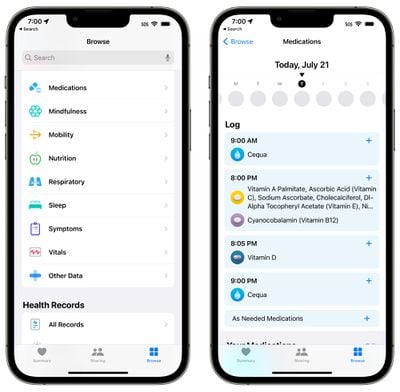
In the Medications app, you can enter all the prescription medications, over-the-counter medications, and vitamins you take to get reminders to take medications, check interactions, and more.
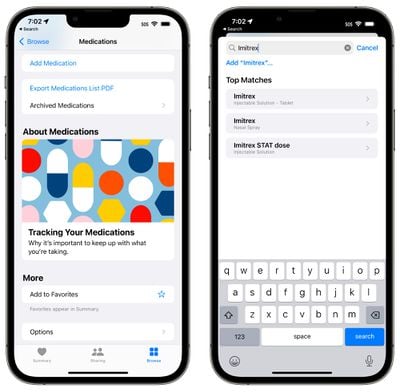
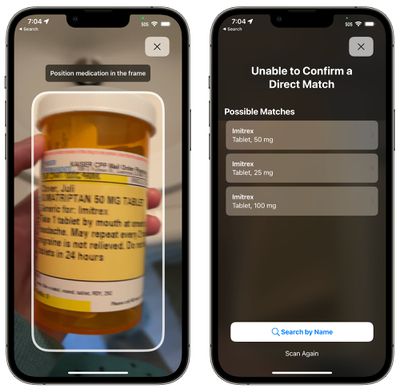
Adding a drug is as easy as tapping the Add Drug button in the Health app. From there, you can type in the name of a drug or vitamin, or use your iPhone’s camera to scan the label of your pill bottle. Adding by scan is simple, but it doesn’t always retrieve all the information, so you may need to manually select the dose and form (pill, spray, etc.).
From there, you can choose how often you take the medication. You can choose a specific day or a range of days, specific days of the week, or opt in as needed, and then you can set the time you want to take the medicine.
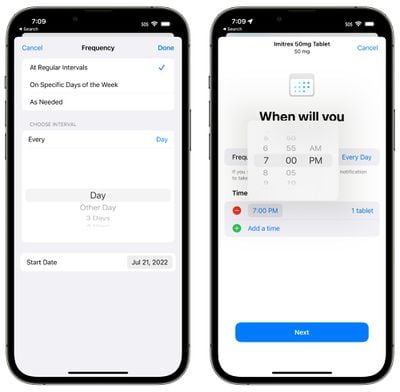
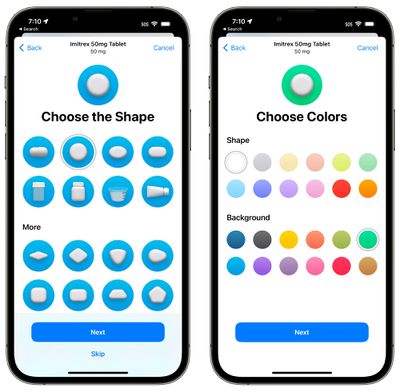
Medications can be customized with a shape and color to match the pill you take in real life for quick and easy recognition.
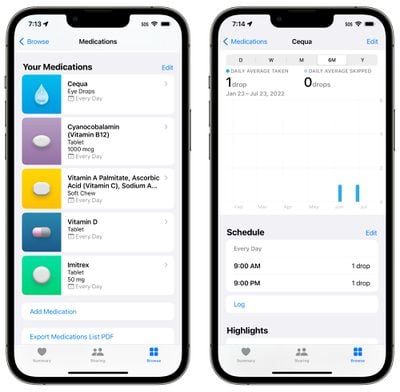
You can add all of your medications and vitamins in the Health app, with everything visible in a list.
Medication reminders
Once you’ve added your medicine to the Health app and set a time and day to take it, the iPhone will send you a notification when it’s time to take it. You can receive notifications for all medications from the Health app that have a schedule assigned to them.
Medication notifications are classified as time sensitive notifications and will be delivered at the time you specified unless you override the setting.
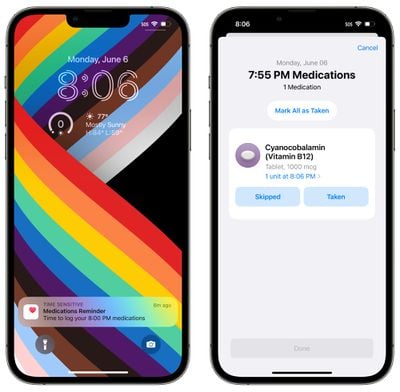
Notifications are automatic for all drugs whose time and/or day are defined for taking.
Medication Logging
When a reminder notification appears, you can tap it to be taken to a pop-up window where you can mark a medication as “Take” or Skipped.” You can also use the “Mark All As Taken” option if you have multiple medications scheduled for Medications can also be marked as saved from the medication list in the Health app.
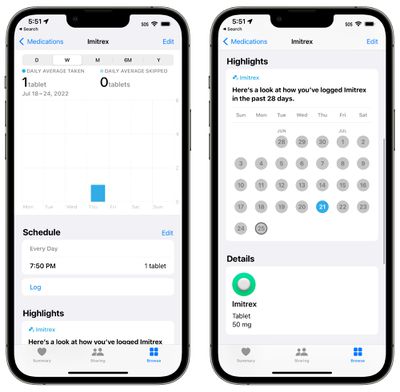
The Health app can track the medications you take over time, so you can check if you’re taking your medications regularly. You can view data organized by day, week, month, six months, and year.
Apple will also provide a Medication Highlight in your Health Summary that will let you know how often you’ve taken a medication in the past 28 days.
Apple Watch Medication App
In watchOS 9, there is a dedicated medication app that you can use for faster sign-in. You can save each medicine individually in the app or use “Save all medicines taken” to view them all at once. If you have missed a dose, you can choose the “Skipped” option.
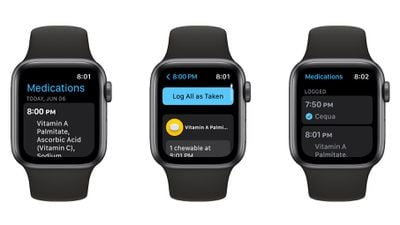
The Apple Watch app is only for marking medications as taken and all other medication management should be done in the Health app.
Drugs interactions
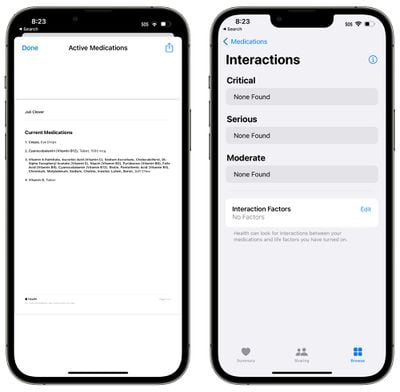
The Health app regularly checks that the medications you are taking do not interact with each other, thus preventing you from taking a combination of medications that could be dangerous.
Medication Side Effects and Other Information
If you tap into a drug from your Health app’s list, you can then choose the “Side Effects” button to see the side effects listed for that drug, if available.
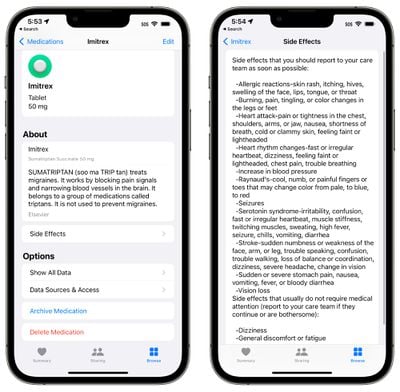
Not all drugs have listed side effects, and the information is provided by Elsevier, a Netherlands-based company specializing in medical content, including the annual ScienceDirect book series on drug side effects.
Export drugs
In the Medications section of the Health app, there’s an option to “Export Medication List to PDF”, which, as the name suggests, creates a simple PDF file of the medications you’re taking. You can share this list with a doctor.
Sleep features
For those who wear the Apple Watch to bed for sleep tracking purposes, watchOS 9 and iOS 16 bring new features. The sleep recorded by the Apple Watch is divided into Awake, REM, Core (light) and Deep sleep categories, so you can get an idea of the quality of your sleep during the night.
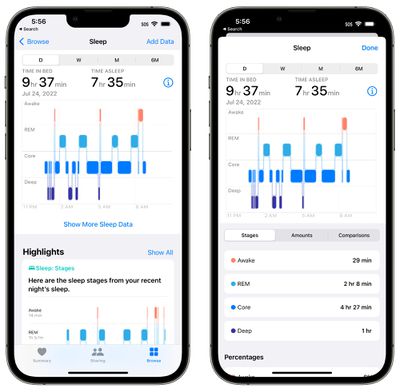
The Apple Watch will track when you go to bed, how long it takes you to fall asleep, how often you wake up, and how long you spend in REM, central, and deep sleep.
Apple defines the different categories of sleep as follows:
- Awake – You may find yourself awake during parts of a sleep session. It is normal for people to wake up occasionally. You may fall back asleep right away and don’t remember waking up during the night.
- REM – This stage of sleep may play a role in learning and memory. During this stage, your muscles are most relaxed and your eyes move rapidly from side to side. This is also when most of your dreams happen.
- Heart – Sometimes called light sleep, this stage is considered as important as the others. This stage often accounts for most of your sleep time each night. Brain waves that may be important for cognition occur during this stage.
- Deep – Also known as slow wave sleep due to brain wave patterns, this is the stage where body tissues are repaired and essential hormones are released. This stage usually occurs over longer periods during the first half of your sleep session.
Sleep data collected by the Apple Watch can be viewed in the “Sleep” section of the Health app. Sleep data can now be viewed by day rather than by week so you can dig deeper into your day-to-day sleep quality.
Other than the new sleep categories, the sleep functionality is the same. You still use the same Bedtime and Wake Up features, which tie into the Wind Down and Sleep Focus options.
Health Sharing Invitations
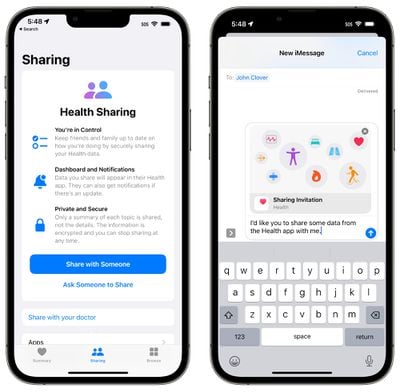
You can invite family members to share their data with you in iOS 16, making it easier to track health information for elderly family members or children. Once an invitation is received, the person can choose to select which data to share with you.
Physical activity tracking
In iOS 15 and earlier, you needed an Apple Watch to take advantage of the Fitness app, but that changed in iOS 16.
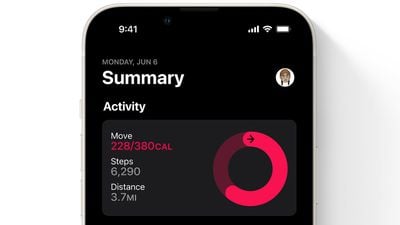
You can use the Fitness app with the iPhone motion sensors to track your activity level. The iPhone can estimate steps, distance traveled, and track third-party workouts to provide details on how many calories you’ve burned in a day.
Without an Apple Watch, you’re limited to a daily movement goal, with no exercise and position goals available.
Guides’ comments
Have questions about the new health and fitness features in iOS 16, know of a feature we left out, or want to provide feedback on this guide? Email us here.