
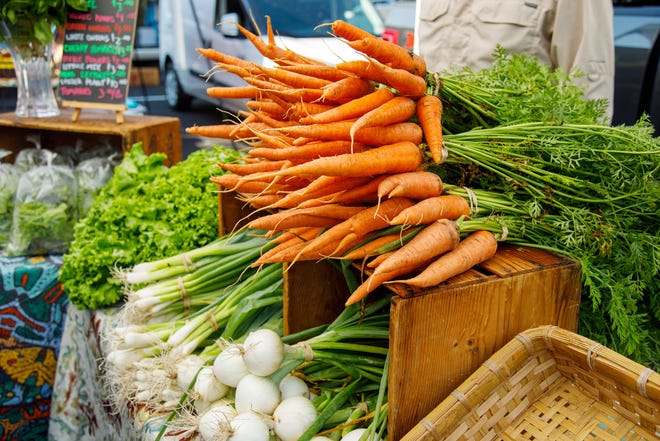
Better access to locally grown produce means more food sold.
That was the reasoning of DeKalb Farmers Market manager Virginia Filicetti when she opted to allow people to buy vendors’ fruits and vegetables with federal food aid. The market has been granted permission to do so under the LINK – Illinois version of the Supplemental Nutrition Assistance Program (SNAP).
“The bulk of our customers in the marketplace are LINK users, which is a huge incentive for the marketplace and our suppliers,” Filicetti told FarmWeek in a recent interview. “Vendors get LINK customers and customers get fresh vegetables and fruits from local farmers.”
The market every Thursday is the only one in DeKalb County to accept LINK dollars and match them through LINK Up Illinois. The matching program allows LINK cardholders who spend $25 at farmers’ markets to receive $25 in matching that can be spent on fruits and vegetables from the market.
The program has become so popular that on the first day of the 2022 season, the market ran out of vouchers for the extra benefits. It is also popular with sellers.
“It’s an incentive for sellers to come back every year – a lot of their market revenue comes from LINK spending,” Filicetti said, noting that the average LINK dollars spent on the market each week is around $400. $.
DeKalb’s experience largely aligns with a statewide trend.
A FarmWeek analysis of USDA Food and Nutrition Service (FNS) data found that the number of Illinois direct marketers and farmers’ markets accepting LINK has skyrocketed since the policy was put in place. almost 15 years ago. The same is true for the amount of LINK benefits spent on food sold directly by those farmers and in those markets.
In fiscal year 2010 – the first full market season in which sellers could accept LINK dollars – just over $41,000 in Advantage was traded at 22 markets across Illinois, which represents 0.14% of the $2.78 million in total benefits traded.
In fiscal year 2020, more than $371,000 in perks was spent at 94 Illinois farmers’ markets, representing 1.1% of the $3.37 million in total perks redeemed.
The same progression was played out at the national level.
In fiscal 2010, approximately 1.2% of the total US$64.70 million in SNAP benefits were redeemed in direct sales at 1,611 different farmer’s markets.
In fiscal year 2020, approximately 4.5% of SNAP’s total US$74.11 million was spent at 4,656 farmers’ markets.
“Quite frankly, this has tremendous economic and health benefits for the community,” Janie Maxwell, executive director of the Illinois Farmers Market Association, told FarmWeek.
“(Using LINK at Farmers Markets) means a steady stream of income for a Farmer in the Market, increased sales and a larger customer base who can use the Farmers Market and bring them more profit,” said Maxwell.
For every dollar of LINK benefits traded on a farmers market, approximately $1.71 is reinvested in the community that hosts the market, according to Maxwell.
“It’s huge,” Maxwell added. “If you’re a LINK user, you can go to a local big box store, but it still supports great business. Here, you support a local producer and their products.
How Farmers Markets Administer LINK
The rules for using LINK dollars at farmers’ markets or when selling directly to a farmer, such as at a roadside produce stand, are simple: the money can be used for most food items fresh, with the exception of hot meals ready to take away.
The policy, however, becomes more complicated for the individual provider or the marketplace itself, which must use Electronic Benefits Transfer (EBT) equipment for LINK transactions.
Maxwell said the purchase of EBT equipment has been a minor barrier preventing some markets or farmers from participating in the program, but grants are available to offset some of the costs.
In DeKalb, market organizers attempted to ease the equipment burden by implementing an EBT token system, in which LINK customers charge their LINK card in exchange for equivalent dollar tokens. Customers give the tokens to sellers, which are returned to market officials, who reimburse the sellers.
“It really simplifies the process and there is no confusion between suppliers and customers,” Filicetti said.
The biggest hurdle is faced by volunteer-run marketplaces, which often don’t have the staff or capital to administer the LINK program in their marketplace, Maxwell said.
This was the case at the bi-weekly Macomb Farmers Market, where John Greenwood, Specialist Grower and Market Manager, first applied in 2021 as an Individual Direct Marketing Farmer, as the market larger did not have the resources to implement LINK acceptance for every vendor. .
“We are all volunteer managers and members. You know, we rarely have time to do everything else, not to mention the administrative work required to run SNAP across the market,” Greenwood said.
He estimated that it would take 12 hours per week plus other costs to run the program for each vendor.
Markets are more successful than direct marketing farmers
Despite the success of other markets and individual farmers with LINK customers, Greenwood itself does not plan to renew its own authorization to accept benefits.
“I thought it would take off for our market,” Greenwood said. “Unfortunately, I didn’t get the response I was hoping for. It didn’t go as planned.”
Greenwood estimated that no more than 10 customers with LINK benefits purchased its tomatoes, lettuce and other fresh produce during the 2021 market season.
“Another seller taking LINK, she sells meat, she got a better response,” Greenwood said. “I don’t know if I’m typical or not, but here in west-central Illinois I am (weak response).”
Greenwood said he wasn’t sure what was behind the weak response – it could be a lack of education or other factors like the COVID-19 pandemic and inflation.
Filicetti said she attributes part of the DeKalb Farmers Market’s success to word of mouth and building relationships between customers and vendors, who “see a lot of the same faces every week.”
“We even have non-LINK customers asking about the program,” Filicetti said. “And many vendors are totally behind the program, they’re communicating it, and those who can’t accept LINK are disappointed that they can’t accept those dollars.”
Greenwood, who this market season will not be able to accept LINK benefits, said he still supports the program. And he is working with a local organization to apply for a grant to cover the costs of implementing the market.
“Hopefully in the future we’ll have the popularity or the funds to be able to fund it in the broader market,” Greenwood said. “It’s like any government program – use it or lose it.”
This story was distributed as a cooperative project between the Illinois Farm Bureau and the Illinois Press Association. For more food and agriculture news, visitFarmWeekNow.com.