
NEWYou can now listen to Fox News articles!
China sent its new Wentian lab module into space on Sunday to be part of its growing orbiting space station, but scientists aren’t sure exactly where debris from the launch will eventually crash into Earth.
China used the heavy Long March 5B rocket to send the Wentian lab into orbit, but the rocket’s massive weight of more than 1.8 million pounds means it is unlikely to burn out completely on reentry.
“Unfortunately, it is likely that the 21-tonne core stage will be left in low orbit to perform an uncontrolled re-entry to an unpredictable location,” Jonathan McDowell, an astronomer at the Center for Astrophysics, tweeted on Sunday.
According to the Washington Post, experts say the debris is highly unlikely to hit a populated area, but the uncertainty makes it unnecessarily risky. A study from earlier this year noted that in 2020 and 2021, parts of Chinese Long March 5B rockets crashed. While one landed in the Indian Ocean, debris from the others damaged Ivorian villages.
SPACE COMMAND HEAD RESPONDS TO THREATS FROM CHINA AND RUSSIA; CALLS FOR INTERNATIONAL STANDARDS: “IT’S THE WILD, THE FAR WEST”
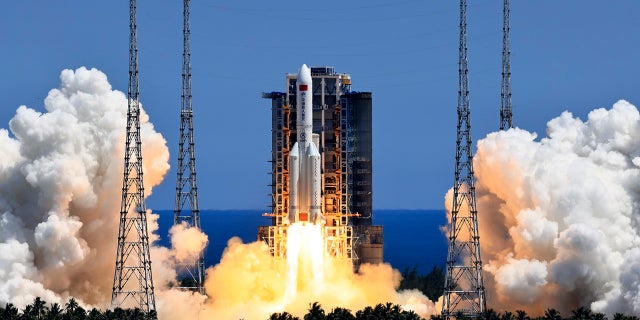
In this photo released by Xinhua News Agency, the Long March 5B Y3 carrier rocket, carrying the Wentian laboratory module, takes off from the Wenchang Space Launch Center in Wenchang, southern China’s Hainan Province , Sunday, July 24, 2022. On a hot Sunday afternoon, with a large crowd of amateur photographers and space enthusiasts in front of China, China launched the Wentian laboratory module from the tropical island of Hainan. (Li Gang/Xinhua via AP)
(Xinhua)
Even after last year’s launch debris landed in the ocean, NASA Administrator Bill Nelson said the country “didn’t meet responsible standards for their space debris,” the report reported. Post.
The Wentian lab launch was the third since China’s space station construction began. The launch was carried out in the island province of Hainan, as onlookers watched. The Chinese Manned Space Agency said the lab docked about 13 hours later with the Tiangong space station.
Three astronauts welcomed the module and supervised the docking. They are in the middle of a six-month stay on the space station which began in June.
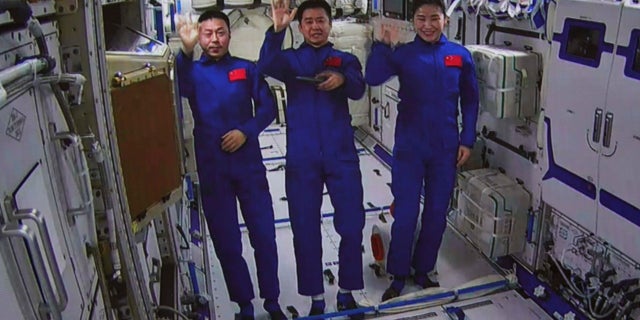
In this photo released by the Xinhua News Agency, an image taken off-screen at the Beijing Aerospace Control Center shows Chinese astronauts from left to right Cai Xuzhe, Chen Dong and Liu Yang salute from inside the module of the Wentian Laboratory on Monday, July 25, 2022. China added the laboratory to its permanent orbiting space station on Monday as it prepares to complete the structure in the coming months. (Guo Zhongzheng/Xinhua via AP)
(Xinhua)
Another laboratory module should go up in October.
US CONDEMNS RUSSIA FOR EXPLODING ITS OWN SATELLITE AND CREATING SPACE DEBRIS
China has not only been called out for its negligence over space debris landing on the ground, but also in space. On Tuesday, the US Space Force’s chief of space operations, General John ‘Jay’ Raymond, said China was among the culprits for conducting tests of destructive direct-ascent anti-satellite missiles.
Raymond recalled that in 2007, China conducted a test that created 3,000 pieces of debris that could threaten existing satellites and pose dangers to astronauts.
CLICK HERE TO GET THE FOX NEWS APP
In April, Vice President Kamala Harris announced that the United States would not conduct such tests, as part of an effort to establish standards for conduct in outer space.
“These tests, of course, are reckless and irresponsible,” Harris said.
The Associated Press contributed to this report.