
Deep in the recesses of Malviya Nagar, where narrow alleyways twist and twist and explode into corridors of drooping electric wires, butchers and chickens, houses and landlords, schoolchildren and parents, cafes and pizzerias, is a place of worship.
This is the Begumpur Mosque, but if you ask directions to the cloistered locality in search of it, you will not immediately be directed there. You’ll first be directed to a smaller property, sandwiched between private residences and general stores, with faint verses of the namaz floating out of its green wooden doors.
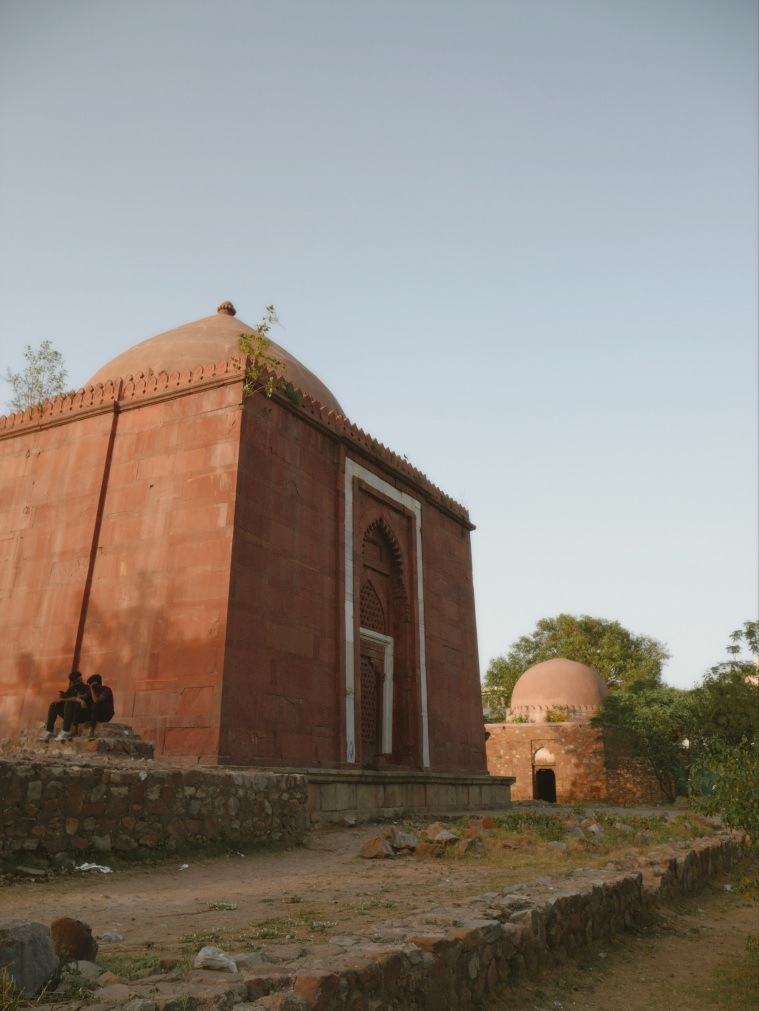 Lal Gumbad in Begumpur. (Express photo by Sara Singh)
Then you should turn around, walk towards a spectator who is already looking at you with curiosity and clarify: no, you are not looking for the mosque in which we worship, you are looking for the mosque in which we worshipped.
Sam Dalrymple awaits us at the top of the stone steps leading to the mosque, this one much larger than the other. He is the co-founder of Project Dastaan, a virtual reality company launched in 2018 that offers survivors of partition in India and Pakistan a glimpse of the homes they abandoned in 1947. He is also working on a book, Five Partitions: The Making of Modern Asia, which seeks to highlight the multiple partitions across South Asia that were a consequence of British imperial conquest.
Dalrymple believes the village of Begumpur in Malviya Nagar – a village that has been inundated with everything from unknown refugees to unfamiliar cuisines following the biggest migration in human history – is a key Delhi enclave that has been forgotten in its urbanized folds.
 Sam Dalrymple is the co-founder of Project Dastaan, a virtual reality company launched in 2018 that gives survivors of partition in India and Pakistan a glimpse of the homes they abandoned in 1947. (Express photo by Sara Singh)
“Imagine you are standing in Old Delhi. Before the Mughal Empire, under the rule of the Delhi Sultanate, this was the center of Delhi,” Dalrymple begins, as we enter the mosque. A vast square courtyard stretches out in front of us, enclosed on all sides by domes dating from the 14th century. “When Muhammad bin Tughlaq was in power, Begumpur was part of his capital, Jahanpanah. And this mosque was the largest in northern India.
Today, however, the mosque is Delhi’s second largest (spoofed in the 17th century by its more popular sibling, the Jama Masjid) and yet “hardly anyone knows about it”, says Dalrymple.
He points to the dilapidated state of the nearly 1,000m² courtyard – no one worships here today. We are surrounded by cracked and crumbling domes. The roof was sealed off because someone fell and died five years ago. According to Dalrymple, there have been attempts to renovate the space by the Archaeological Survey of India (ASI), but none have been successful.
 Ruined domes of Begumpur Mosque. (Express photo by Sara Singh)
“What’s weird, though, is that we don’t even know who built it,” says Dalrymple. “We believe it is the prime minister of Feroz Shah Tughlaq, but even Ibn Battuta – the great Moroccan traveler who gave us some of the best accounts of medieval India – does not mention this mosque at all.”
When Feroz Shah succeeded Tughlaq, Jahanpanah was abandoned in favor of the new capital, Firozabad. But the people of Begumpur stayed, building a village in what we know today as Malviya Nagar. They built houses – 97 in number – just inside the mosque, houses which remained in place until it was acquired by the ASI six centuries later in 1927. Residents have received compensation of Rs 18,179, and the houses inside were demolished.
But soon after, something new happened in their place.
“So many of the score stories you hear have to do with violence, but the most important thing you hear from Begumpur?” says Dalrymple, “The arrival of Punjabi cuisine. Dal makhani was this major invention that no one had ever tried before. You had all these families coming from Multan, Pakistan, and to this day there is a large community of Multani Hindus living here.
Even until the 1960s farms dominated the area, but in the 1980s student residences, cafes and “all sorts of candle places” led to sudden urban development. However, that history is now colorless, in ruins, and yearning for its former glory. As we leave the compound, Dalrymple elaborates Ibn Battuta’s writings on Begumpur, which are rich in architectural descriptions of wood, paint, tiles and shamianas – none of which survive today.
“A lot of Mughal-era monuments that we see are only half the story because the importance of tents and mats was huge,” says Dalrymple, alluding to how monuments of the time used draperies such as walls and doors.
We note a similar absence when we reach the Lal Gumbad complex of Begumpur, the tomb of the Sufi saint Sheikh Kabir-ud-din Auliya who died in 1397. Around the tall red sandstone structure, children fly kites and dogs roam on a leash. Skinny men sit outside the padlocked entrance to the tomb, in sandals, slacks and shirts with rolled up sleeves, playing cards and smoking.
“Centuries ago you would have seen a tent passage from here to the mosque,” Dalrymple traces an arc with his finger in the air, “There would have been rugs and people selling flowers. the ASI has taken over, you can’t worship here either.
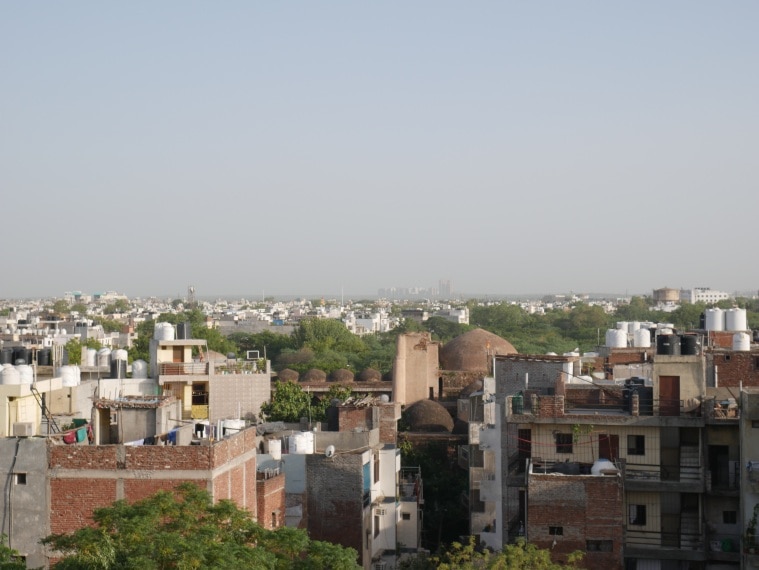 From the top of Vijay Mandal. (Express photo by Sara Singh)
Ibn Battuta’s writings tell us of our final destination in Begumpur, one of Delhi’s oldest palaces, the Vijay Mandal – The Hall of a Thousand Columns, as Battuta calls it. “But of course,” says Dalrymple, “there are no more columns. They were all wooden. It was once the great residence of Muhammad bin Tughlaq, now overgrown with tall uncut grass, cigarette butts occasional and not a single chowkidar in sight.
“Begumpur is not well documented. There is less interest in this period than in the Mughal era,” says Dalrymple as we find a small marble shrine of a Sufi saint behind the palace. It sits under a large peepal tree, surrounded by a few unlit diyas and fresh marigold flowers.
“I find these shrines very reassuring,” says Dalrymple. “It’s not a massive construction, and just a place where Hindus and Muslims still come to pray. The peepal tree is sacred to Hinduism and has no relevance in Islam, yet it is a Sufi saint buried here.
Dalrymple’s true destination in these lands, however, is a little higher up. We climb a steep, narrow stone staircase in the palace to emerge at the top and look around: “That’s the best view you can get of South Delhi,” he says, raising his arm in the air. Delhi’s unusually clear skyline that is already sinking. its sun below the horizon.
We see everything from the flats of Lal Gumbad and Begumpur to the distant Qutub Minar complex and Siri Fort. Closest to us, however, is a scrawny boy leaping from dome to dome of the Begumpur Mosque, braving the slippery stone not in pursuit of religion or prayer, but simply pleasure.