
We don’t see much progress with US antitrust legislation at the moment, but if both bills make it through the Senate, it raises the possibility of Apple’s default apps being banned. That is, Apple could not pre-install its own stock apps on iPhones, but instead had to offer customers a choice of basic apps.
Above is an illustration of how Apple might respond, offering a choice of key apps during the initial iPhone setup, likely with its own apps topping the list…
Background
We summarized the context earlier today:
There are growing concerns about the power and market dominance of a small number of tech giants. Congress has worked on several antitrust bills, each designed to address different issues. Two of them have progressed to the point where they are ready for a vote:
It’s this second bill that poses the biggest threat to Apple, requiring big changes to the App Store’s business model, including allowing third-party app stores.
Apple’s Default Apps Could Be Banned
Another impact could be that Apple is no longer allowed to favor its stock apps over third-party ones by pre-installing them on iPhones.
This raises the question of how customers would get a properly functioning iPhone right out of the box. Bloomberg suggests that one approach would be for part of the setup process to require users to choose basic applications such as the web browser, music player, and maps. The illustration above gives a general idea of what this might look like.
Apple could go further
However, given the company’s very aggressive response to such measures, Apple may well be doing much more than putting its own apps at the top of the list.
For example, antitrust actions forced Apple to allow third-party payment for certain in-app purchases. The iPhone maker vigorously opposes this, displaying a warning message clearly designed to scare users into rejecting this option. This is the one Netflix users see when opting into the video streaming company’s payment service:
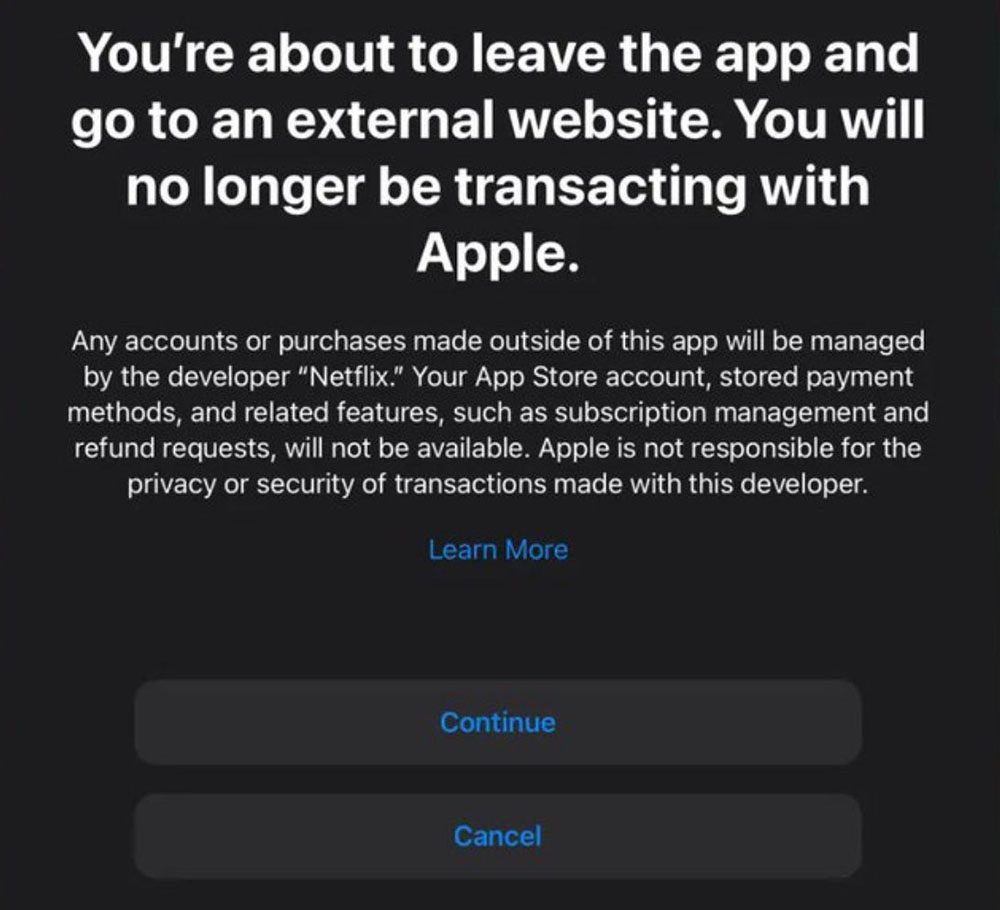
This is a classic example of FUD: creating fear, uncertainty, and doubt about the action the company doesn’t want you to take. This was an approach allegedly used by IBM in the 1970s, with the phrase “No one was ever fired for buying IBM”.
I wouldn’t be at all surprised to see similar messages if you choose to install third-party apps instead of Apple’s. For example, the company might show something like this if you select Spotify instead of Apple Music:
You are about to select an app provided by a third-party developer, instead of an Apple app.
Apple is not responsible for the privacy or security of any data provided to this developer.
Also, you won’t be able to get a free trial of Apple Music and may have reduced functionality when using Mac, iPad, Apple Watch, and HomePods.
It wouldn’t be at all difficult for Apple to craft warning messages that are technically true, but scare anyone considering stepping out of the company’s ecosystem.
FTC: We use revenue-generating automatic affiliate links. After.

Check out 9to5Mac on YouTube for more Apple news: